
Mental health deserves attention long before difficulties become overwhelming. What does research tell us about mental health prevention, and how can we create better conditions for mental wellbeing in everyday life?
Mental health often receives attention only when difficulties become hard to manage. Yet our wellbeing is shaped long before a crisis by how we live and work, the relationships around us, and whether support is available when we need it.
A preventive approach aims to reduce avoidable risks, strengthen the conditions that support wellbeing, and recognise difficulties early. It does not mean that all mental health problems can be prevented, or that everyday wellbeing practices can replace professional care.
Research increasingly highlights the importance of prevention, although not all approaches have the same level of evidence behind them. Understanding what works, for whom, and under which circumstances is essential.
In this article, we explore what mental health prevention means, what scientific research tells us, and how individuals, organisations, and communities can contribute to better mental wellbeing.
Why prevention matters
Mental health is not simply the absence of illness. It affects how we relate to other people, cope with change, participate in daily life, and make decisions. Paying attention to it early can help us build resources for everyday demands and recognise when additional support may be needed.
The Danish National Health Profile 2025 found that 29.5% of people aged 16 and over scored highly on a measure of perceived stress, compared with 21.0% in 2010 [1]. These figures describe people’s reported experiences of stress, not the proportion diagnosed with a mental health condition. They nevertheless underline why strengthening mental wellbeing matters in Denmark.
Prevention matters to individuals, but also to workplaces, families, organisations, and communities. When people have better access to supportive environments and useful knowledge, they have more opportunities to respond to challenges before problems become overwhelming.
What prevention means
Mental health prevention brings together several related approaches. Mental health promotion strengthens the conditions that support wellbeing, such as healthy relationships and opportunities to participate. Targeted prevention provides support to people facing identifiable risks or early symptoms. Early recognition helps people notice changes and find appropriate support sooner.
These approaches operate at different levels, but share a practical purpose: making it easier to understand mental health, strengthen wellbeing, and act when difficulties first emerge.

Why understanding our minds matters: psychoeducation
A central part of prevention is learning to understand our mental and emotional lives. Psychoeducation makes psychological knowledge accessible and useful: how the brain and body respond to stress, how thoughts influence emotions and behaviour, and how mental habits can shape everyday experiences.
This knowledge can help us recognise changes earlier. Someone who understands that prolonged stress can affect concentration, sleep, and mood may notice those signs sooner and respond before feeling overwhelmed. Understanding emotions can also help us recognise our reactions, communicate our needs, and make more thoughtful choices in difficult situations.
Researchers often use the term “mental health literacy” to describe a broader ability to understand mental health, recognise difficulties, know which strategies may help, and find appropriate support [6]. Psychoeducation contributes to prevention by turning knowledge into awareness, practical choices, and opportunities for earlier action.
What scientific research tells us
Psychological interventions can help prevent depression
Research suggests that preventive psychological interventions can reduce the risk of developing depression among adults who are already experiencing early symptoms.
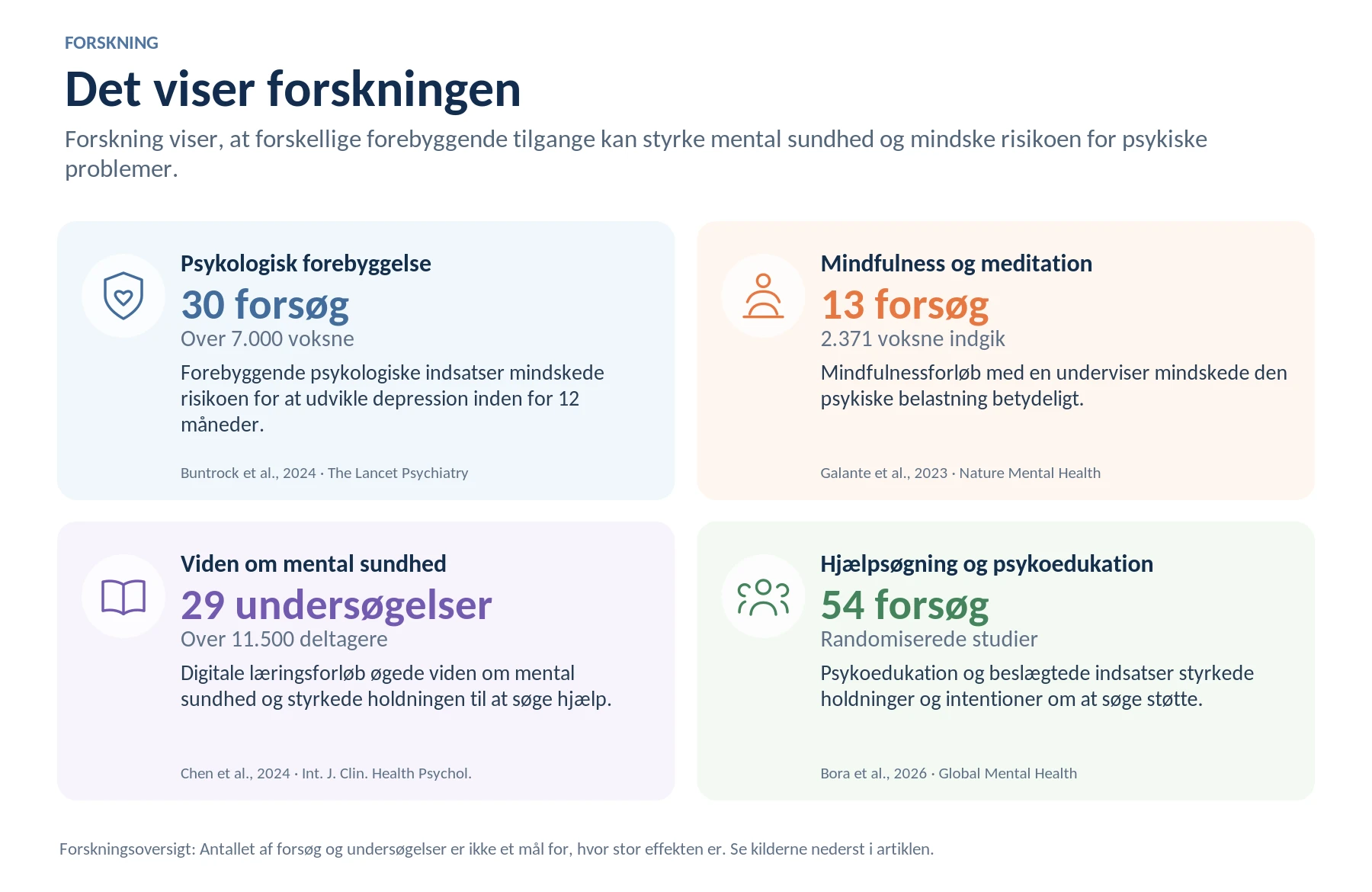
A major review published in The Lancet Psychiatry in 2024 examined 30 randomised trials involving more than 7,000 adults. It found that preventive psychological interventions reduced the likelihood of developing major depression during the following year [2].
These findings demonstrate the potential value of acting early, before psychological difficulties develop into more serious mental health conditions.
The benefits of mindfulness and meditation
Mindfulness and meditation are among the most extensively studied approaches to supporting mental wellbeing. Research suggests that they can reduce stress and psychological distress and improve aspects of emotional wellbeing.
A systematic review published in Nature Mental Health in 2023 found that structured, teacher-led mindfulness programmes significantly reduced psychological distress among participating adults [3].
These findings support the value of mindfulness and meditation as practical tools for mental wellbeing. They can help people become more aware of their thoughts, emotions, and reactions, and respond more consciously to everyday challenges.
Psychoeducation and mental health literacy
Research also supports educational approaches to mental health. A 2024 meta-analysis of 29 studies involving more than 11,500 participants found that digital mental-health-literacy programmes improved knowledge, attitudes towards seeking help, and some mental health outcomes [4]. A 2026 systematic review of 54 randomised studies also identified psychoeducation and mental health literacy as effective elements in programmes that encourage help-seeking [5].
These findings underline the value of helping people understand mental health and recognise when action or support may be useful.

Five foundations of mental wellbeing
Mental wellbeing is shaped by several interconnected factors, including social relationships, physical activity, adequate sleep, a sense of purpose, and the environments in which we live and work [7, 8, 9, 10]. These factors are not isolated habits: they interact with one another and with the wider conditions of everyday life.
1. Social connection and belonging
Meaningful relationships provide emotional support, strengthen our sense of belonging, and help us navigate difficult periods. Regular contact with friends, family, colleagues, or community groups can make a difference. The quality of these connections often matters more than the number of people we know.
2. Physical activity and restorative rest
Movement supports both physical and psychological health. Walking, cycling, yoga, dancing, and other forms of physical activity can improve mood and help reduce stress. Adequate sleep and opportunities for rest are equally important for maintaining energy, concentration, and emotional balance.
3. Mindfulness, meditation, and awareness
Mindfulness and meditation help us develop a more attentive relationship with our thoughts, emotions, and physical sensations. Regular practice may reduce psychological distress, improve awareness of stress reactions, and help us respond to challenges with greater clarity.
These skills can be developed through formal meditation, mindful movement, or everyday activities such as walking, eating, and listening attentively to another person.
4. Meaning and participation
Having opportunities to contribute, learn, create, and participate in meaningful activities can support a sense of purpose. This may come through employment, volunteering, personal interests, family responsibilities, or participation in a local community.
5. Supportive everyday environments
Mental wellbeing is also influenced by the conditions around us. Workplaces where people feel respected, communities that encourage participation, and environments that support social connection can make it easier to maintain mental wellbeing.
Together, these foundations offer several ways to support mental wellbeing in everyday life. Their impact depends not only on individual choices, but also on the relationships and environments that make those choices possible.

A minute of mindful awareness
Mindfulness does not always require a lengthy meditation session. A brief moment of awareness can help us notice how we feel and create space between an experience and our response.
Find a comfortable position and allow your attention to settle on the present moment.
Notice the contact between your body and the chair or the ground. Become aware of your breathing without trying to change it. Observe any tension, sensations, or thoughts that arise, allowing them to be present without reacting immediately.
After about a minute, gently return your attention to your surroundings.
This simple practice offers an opportunity to become more familiar with your mental and physical responses. Practised regularly, mindful awareness can become a useful part of everyday life.
Prevention is also a collective responsibility
Our everyday choices matter, but prevention cannot rest on individuals alone. The conditions in which we live and work shape how easy it is to sleep well, maintain relationships, feel safe, and access support. A person can develop useful stress-management skills and still struggle in an environment with unmanageable demands or little social support [8, 10].
Workplaces can contribute by creating realistic workloads, respectful communication, and opportunities to seek help without stigma. Schools, public institutions, and community organisations can make mental health knowledge easier to access and provide welcoming places for participation. Public policy also matters, from access to appropriate services to the social conditions that influence wellbeing.
Workplaces can take practical steps to reduce unnecessary stress. For example, organisations can establish clear expectations about email and messages outside working hours, allowing employees to disconnect without feeling they must remain constantly available. Managers can regularly review task distribution, clarify responsibilities and priorities, and adjust workloads when demands exceed available time and resources [10].
These organisational measures, combined with opportunities to develop skills such as mindfulness, emotional awareness, and stress management, can help create healthier and more supportive working environments.
The strongest approach combines what people can learn and practise with environments that make wellbeing possible. Prevention becomes more meaningful when knowledge, practical support, and shared responsibility reinforce one another.
The Onivers approach: knowledge, practice, and community
At Onivers, we believe that supporting mental wellbeing should be a natural part of everyday life, not something we consider only when difficulties arise.
As a nonprofit association based in Copenhagen, Onivers brings together knowledge, practical tools, and community participation to make mental health and wellbeing more accessible.
At Onivers, psychoeducation helps make topics such as stress, emotional responses, and everyday mental habits easier to understand. Mindfulness, meditation, and yoga offer practical opportunities to apply that knowledge, while community activities create space to learn and connect with others.
Together, these approaches illustrate how knowledge, practice, and community can support mental wellbeing as part of everyday life and contribute to prevention.
Prevention begins before a crisis
Mental health deserves attention throughout life, not only when difficulties become overwhelming.
Research highlights the value of preventive approaches, from psychological interventions and psychoeducation to mindfulness, supportive relationships, physical activity, and healthier environments.
Understanding how our minds work gives us knowledge. Developing practical skills gives us tools. Supportive relationships and communities create opportunities to put both into everyday practice.
By making these resources more accessible, we can support mental wellbeing and contribute to a society where prevention becomes a natural part of how we live, work, and care for one another.
Explore Onivers activities and discover opportunities to practise mindfulness, learn, and connect with others.
Sources and further reading
- [1] Den Nationale Sundhedsprofil 2025 — University of Southern Denmark / Danish authorities
- [2] Buntrock, C., et al. (2024). Psychological interventions to prevent the onset of major depression in adults: a systematic review and individual participant data meta-analysis. The Lancet Psychiatry, 11, 990–1001. DOI: 10.1016/S2215-0366(24)00316-X. PMID: 39572120.
- [3] Galante, J., et al. (2023). Systematic review and individual participant data meta-analysis of randomised controlled trials assessing mindfulness-based programs for mental health promotion. Nature Mental Health, 1, 462–476. DOI: 10.1038/s44220-023-00081-5.
- [4] Chen, Q., et al. (2024). Digital empowerment in mental health: A meta-analysis of internet-based interventions for enhancing mental health literacy. International Journal of Clinical and Health Psychology, 24(3), 100489. DOI: 10.1016/j.ijchp.2024.100489. PMCID: PMC11362801.
- [5] Bora, S., et al. (2026). Interventions to improve mental health help-seeking attitudes, intentions and behaviors: A systematic review of recent advances. Global Mental Health, 13, e85. DOI: 10.1017/gmh.2026.10183. PMCID: PMC13125273.
- [6] Jorm, A. F. (2012). Mental health literacy: Empowering the community to take action for better mental health. American Psychologist, 67(3), 231–243. DOI: 10.1037/a0025957. PMID: 22040221.
- [7] Danish Health Authority. What promotes mental health?
- [8] World Health Organization. Mental health: strengthening our response.
- [9] World Health Organization. World report on social connection (2025).
- [10] World Health Organization. Mental health at work.